We got up before dawn this morning for our taxi ride to the airport. The taxi driver decided the best thing to do in the thin traffic was to drive at 120 km/h in 60 km/h zones, swerve wildly around the one or two cars we encountered, and race the traffic lights. We'd given him no indication we were in a hurry. After checking in at the airport, we wandered around looking at the few duty free shops (but didn't buy anything) and then tried to calculate a perfect combination of bottled waters and snacks we could buy to get rid of our remaining forints. Evan nearly succeeded, coming away with only 200 (about 50c).
The first leg of the trip took us back to Vienna, then came the long haul to Kuala Lumpur. David wasn't doing too well, still suffering from fever and unable to sleep at all. At Kuala Lumpur, we were given the usual 20 minutes to get off the plane and then get back on, so our visit to the duty free shops was brief and purposeful. David, half asleep, decided on an impulse to get a huge 1 kg box of Guylian chocolates, only discovering later what a pain it was to carry around.
We arrived in Sydney early in the morning. When we arrived at the baggage collection area, they started to make announcements listing the names of passengers whose baggage had been left in Vienna. Every few minutes more names would be added and we expected that ours would be among them - not that we would have minded too much: There was nothing in our bags we needed immediately. But no, we got our baggage and made our way through customs - alot more painful than any border control in Europe - to the domestic terminal. After the short hop to Canberra we were met by David's grandma and John, but were too exhausted from the flight to talk a lot about the trip. We were glad to be home, and looking forward to a couple of days' rest to readjust to Australian time.
Showing posts with label Budapest. Show all posts
Showing posts with label Budapest. Show all posts
24 June 2006

23 June 2006
Day 27 - Hungarian Parliament Building
David was unfortunately still sick this morning. Evan arranged for a doctor to come and pay a house call and afterwards walked to the local pharmacy (luckily very close by an Andrassy Utca) to get some supplies. Buying brandname medicines was not difficult but explaining to the pharmacist that I wanted carbon was a little more difficult. After trying a range of descriptions, Evan simply wrote a large 'C' on a piece of paper handed to him by the pharmacist who then understood immediately. Thank heavens for the universal language of science (and those chemistry classes Evan never thought he'd use)!
After setting David up for the day, Evan headed towards the Parliament Building down by the Danube. On the way there, he discovered a bookshop selling an Hungarian cookbook, in English, that could not be had for love or money in Australia. Our previous attempts to get it had ended up with finding people who were prepared to sell it for about USD 300. It was, however, yet another book to take home in an already heavy suitcase.
Evan arrived at the Parliament about an hour before the next English tour--tours were available in a range of languages including Hebrew. They were free for EU citizens but not for the rest, so Evan bought his ticket and had a look around the surrounding streets. Out the front of the Parliament there was a memorial to those massacred in the 1956 uprising, including a Hungarian flag with a hole in the centre (symbolising liberation from the 'foreign' communist regime by removing its coat of arms). Across the road from the Parliament one of the grand old buildings had smallish iron balls arranged in an interesting pattern all over romanesque architecture. They were clearly former bullet holes from the massacre of those who challenged the regime in 1956.

A memorial to those who died in the 1956 uprising, with the Parliament in the background.
The Parliament Building itself was very Victorian and was based on the Houses of Parliament in London. It had the standard gaudy grandness--acres of gold leaf, gothic revival vaulted ceilings etc, and some interesting porcelain statues all over the place symbolising an idealised view of the typical Hungarians at the time. There were the standard two chambers. Near the entrance the tour group was shown a model of the Parliament Building made by a family during the communist times out what appeared to be match sticks. It was so big that the to get it out of their apartment, the authorities had to pull a wall down. The family was rewarded for their patriotism with a new apartment.

The Upper House.

The matchstick parliament.
In the lobby of the Upper House, we were shown the apparently famous numbered brass cigar holders. Members would put their cigars down in a numbered slot to go and hear speeches being made. If the speaker was good, the cigar would burn down and his oratory would be said to be 'worth a Cuban cigar'.
In the central dome, the group was shown St Stephen's crown and other crown jewels in a solid glass case. This is the famous crown with the cross bent at an angle. Why it is bent is a mystery--it may just have been broken at one point but has now become iconic. While we allowed to use flash photography anywhere else in the building, we were asked not to use it on the crown jewels, but of course a handful of people completely ignored this. Tourists!

The Crown of St Stephen, with its distinctive bent cross.
After the Parliament, even did some shopping at Lush, taking advantage of the exchange rate to get some good deals and bath ballistics to cheer David up. It was then back to the hotel for an early night.

The Lush store on Szt. István Krt.
After setting David up for the day, Evan headed towards the Parliament Building down by the Danube. On the way there, he discovered a bookshop selling an Hungarian cookbook, in English, that could not be had for love or money in Australia. Our previous attempts to get it had ended up with finding people who were prepared to sell it for about USD 300. It was, however, yet another book to take home in an already heavy suitcase.
Evan arrived at the Parliament about an hour before the next English tour--tours were available in a range of languages including Hebrew. They were free for EU citizens but not for the rest, so Evan bought his ticket and had a look around the surrounding streets. Out the front of the Parliament there was a memorial to those massacred in the 1956 uprising, including a Hungarian flag with a hole in the centre (symbolising liberation from the 'foreign' communist regime by removing its coat of arms). Across the road from the Parliament one of the grand old buildings had smallish iron balls arranged in an interesting pattern all over romanesque architecture. They were clearly former bullet holes from the massacre of those who challenged the regime in 1956.

The Parliament Building itself was very Victorian and was based on the Houses of Parliament in London. It had the standard gaudy grandness--acres of gold leaf, gothic revival vaulted ceilings etc, and some interesting porcelain statues all over the place symbolising an idealised view of the typical Hungarians at the time. There were the standard two chambers. Near the entrance the tour group was shown a model of the Parliament Building made by a family during the communist times out what appeared to be match sticks. It was so big that the to get it out of their apartment, the authorities had to pull a wall down. The family was rewarded for their patriotism with a new apartment.


In the lobby of the Upper House, we were shown the apparently famous numbered brass cigar holders. Members would put their cigars down in a numbered slot to go and hear speeches being made. If the speaker was good, the cigar would burn down and his oratory would be said to be 'worth a Cuban cigar'.
In the central dome, the group was shown St Stephen's crown and other crown jewels in a solid glass case. This is the famous crown with the cross bent at an angle. Why it is bent is a mystery--it may just have been broken at one point but has now become iconic. While we allowed to use flash photography anywhere else in the building, we were asked not to use it on the crown jewels, but of course a handful of people completely ignored this. Tourists!

After the Parliament, even did some shopping at Lush, taking advantage of the exchange rate to get some good deals and bath ballistics to cheer David up. It was then back to the hotel for an early night.

22 June 2006
Day 26 - Gellért Baths
We started the morning by trying out the thermal baths. Budapest has many, and we decided to try the famous Gellért Baths because of its very grand Art Nouveau architecture (our guide book says it is like "taking a bath in a cathedral"). We took a plunge in the thermal baths and had a swim in the swimming pools, which perhaps better suited the very hot weather.

David spent most of the afternoon in bed, doing his best to recover. Evan went out and did a little shopping. Later that evening, feeling a little better, we had dinner at a cheap vegetarian restaurant, Govinda's.
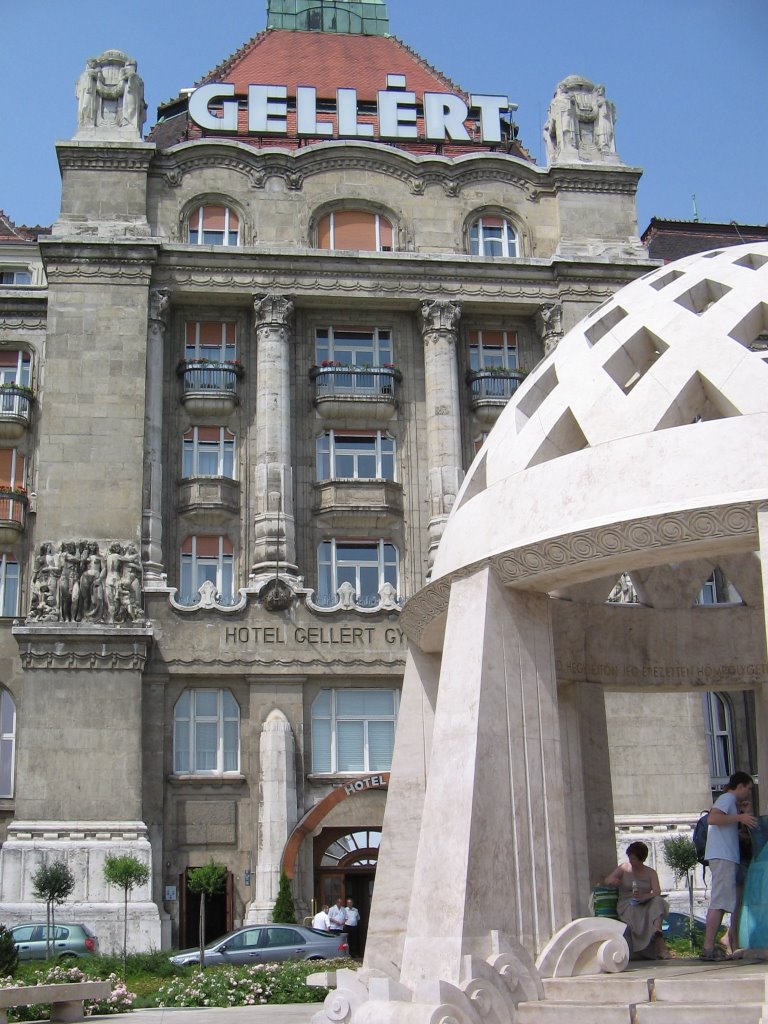
The Gellért Baths.
Taking the tram back into Pest, David wasn't feeling very well and had to get off. We stopped into the nearest store to have a drink to rehydrate and to rest for a moment. We made our way back to the hotel so David could lie down. This was made especially difficult by the traffic chaos that George Bush was still causing.David spent most of the afternoon in bed, doing his best to recover. Evan went out and did a little shopping. Later that evening, feeling a little better, we had dinner at a cheap vegetarian restaurant, Govinda's.
21 June 2006
Day 25 - Buda Hills and Statue Park
We ventured across the other side of the Danube for the first time today. We took a tram over Margaret Bridge to Moszkva tér, and another tram a few stops to the lowest station of the cogwheel railway. This is a train line that goes up the steep slope up into the Buda Hills. This unusual train line counts as public transport, and so was covered by our Budapest Cards.
Getting off at the highest station, Széchenyi Mountain, we walked over to the nearby Children's Railway. This railway is run by the Young Pioneers, originally a Communist Party affiliated youth organisation. Today the Young Pioneers are apolitical and similar in many ways to the Scouts.
Everyone running the railway (except the train driver) is aged between 10 and 14: The ticket seller, signalman, ticket inspector... It's quite remarkable.


The statues and plaques here are interesting. Many are Hungarian-Soviet 'friendship memorials'. Others are statues of figures such as Lenin, and Marx and Engels. A few, perhaps the most controversial, are memorials to those who died fighting against the revoluntionaries in 1956.


Now that our hotel has a kitchen - and after all the expensive restaurants we've been eating at - we went to a supermarket to buy some things to make ourselves dinner. While there we bought ourselves a bottle Tokaji (Tokay) 6 puttonyos (ie. very sweet) wine and a bottle of Unicum.
Getting off at the highest station, Széchenyi Mountain, we walked over to the nearby Children's Railway. This railway is run by the Young Pioneers, originally a Communist Party affiliated youth organisation. Today the Young Pioneers are apolitical and similar in many ways to the Scouts.
Everyone running the railway (except the train driver) is aged between 10 and 14: The ticket seller, signalman, ticket inspector... It's quite remarkable.

Evan in front of the Children's Railway station at Széchenyi Mountain.

A train on the Children's Railway.
We took the train up to the highest point in the mountains, János-hegy. From this station, we walked up to the lookout and then took the chair-lift back down the mountains, which was relaxing and had a good view of the city. We caught a bus back to Moszkva tér, where we had lunch in Mammut (a large shopping centre).
The lookout at János-hegy.

The view from the chair-lift.
Next, we needed to take a tram and then a bus out to Szoborpark, or Statue Park. This park, far out in the suburbs of Budapest is a remarkable place. At the fall of communism in Hungary, communist statues were rounded up and relocated here. The park, situated under tall electricity pylons, is hardly glamourous, and it's a bit neglected. No doubt the exisitance of this park is controversial for many people.The statues and plaques here are interesting. Many are Hungarian-Soviet 'friendship memorials'. Others are statues of figures such as Lenin, and Marx and Engels. A few, perhaps the most controversial, are memorials to those who died fighting against the revoluntionaries in 1956.

Szorborpark.

This statue is interesting. It was created in 1951 as a memorial to Ilja Afonoszejevis Ostapenko, a captain in the Soviet Red Army. It was placed on the highway leading out from Budapest to Vienna, and greeted people as they arrived. After the fall of communism, locals didn't want to get rid of their friendly, waving statue!
Back in the city, the tram we caught didn't cross back into Pest as we expected it to (there were lots of announcements, but they were in Hungarian, so we didn't understand). We had to catch a tram at the next bridge. Then, at the main metro station, Deák Ferenc tér, the platforms for the M1 were closed. Leaving the station to walk down to the next station, we noticed that many of the roads in the centre of the city were closed off. The source of all this inconvience, it turned out, was that George Bush was in town. That explained the US flags we'd seem around.Now that our hotel has a kitchen - and after all the expensive restaurants we've been eating at - we went to a supermarket to buy some things to make ourselves dinner. While there we bought ourselves a bottle Tokaji (Tokay) 6 puttonyos (ie. very sweet) wine and a bottle of Unicum.
20 June 2006
Day 24 - National Museum and Hungarian State Opera
Our first stop was the National Museum at Kálvin tér. To get there we had to change from the historic M1 metro line to the communist-era M3 line. This line is very different, it's much deeper for a start; The 'escalators-of-death' as we called them go very fast, much faster than any other escalators we've been on. Strangely, the handrail moves even faster, so your hand creeps up faster than you do.
The collection in the National Museum is very well presented. It is arranged in roughly chronological order from the stone age through to the 20th Century. Many facinating and varied items are on display. We found the last century particularly interesting, especially the treatment of the two World Wars and the 1956 Revolution. Throughout the communist-era, the propaganda machine denounced the revolution as a counter-revoluntionary revolt, so it is interesting to see it come full circle and be portrayed now as a popular uprising.


The opera tonight was Mozart's The Marriage of Figaro. The Opera House is very grand and very ornate and we had great seats. It was a talented performance and very enjoyable, even though the story was silly. It was a fantastic experience.
Getting out fairly late, we had dinner at a restaurant near our hotel, the Premier Étterem. It was very nice in the hot weather to have dinner outside at this Art Nouveau restaurant. The food was very good and the service was very, very polite: Something we noticed as a trend in Budapest, almost everyone is very polite.
The collection in the National Museum is very well presented. It is arranged in roughly chronological order from the stone age through to the 20th Century. Many facinating and varied items are on display. We found the last century particularly interesting, especially the treatment of the two World Wars and the 1956 Revolution. Throughout the communist-era, the propaganda machine denounced the revolution as a counter-revoluntionary revolt, so it is interesting to see it come full circle and be portrayed now as a popular uprising.

The Hungarian National Museum.
We had planned to visit the Electrotechnical Museum (with the world's largest collection of electrical meters) but it was closed. We stopped at at Cafe Károlyi and had a traditional Hungarian lunch.
Fantastic buildings like this are all over Budapest.
We were walking over to the House of Terror museum in the old secret police building when we found ourselves outside the Opera House. We thought we should go in and have a look and we ended up buying tickets to the performance that night. Suddenly, we didn't have much time left, so we rushed back to the hotel to get changed.The opera tonight was Mozart's The Marriage of Figaro. The Opera House is very grand and very ornate and we had great seats. It was a talented performance and very enjoyable, even though the story was silly. It was a fantastic experience.
Getting out fairly late, we had dinner at a restaurant near our hotel, the Premier Étterem. It was very nice in the hot weather to have dinner outside at this Art Nouveau restaurant. The food was very good and the service was very, very polite: Something we noticed as a trend in Budapest, almost everyone is very polite.
19 June 2006
Day 23 - Down the Danube to Budapest
After breakfast we quickly checked out of our hotel and rushed down to to International Passanger Terminal on the river. We needed to get there early because we had being having trouble booking with the company running the hydrofoil service between Bratislava and Budapest.


The hydrofoil dropped us off at the passanger terminal on the Pest side of the river, in the middle of the city. We walked along Váci utca, probably the most touristy street in Budapest, to the metro station at Vörösmarty tér. Unfortunately one of the wheels on David's bag had decided to give up, making it very painful to drag along.
The ticket officer at the metro station didn't understand any English, but with a few Hungarian words and lots of pointing we were able to buy two Budapest cards, which gives discounts to museums and other attractions, and also free travel on public transport.
The M1 line, also known as the Milleniumi Földalatti (Millennium Underground) is interesting. Dating from 1896, it's the second oldest underground train in the world, after the London Underground. Most of the stations have been restored to their appearance at the turn of the century. One of the most remarkable things about it is that it runs just under the surface. We got off at Bajza utca (you can hear the poker-machine-sounding announcement) and our hotel, the Radio Inn, was just around the corner.

After resting, we went to dinner at the irresistibly named Marquis de Salade. The restaurant specialises in Azerbaijani dishes and the food was delicious, fresh and suited the warm weather perfectly (the cool cellar the restaurant was in also helped). The waiter was exceptionally polite.
Afterwards took the metro back up to Hősök tere (Heroes' Square) and wandered down Andrássy út to the apartment building where David's family once lived.


Another hydrofoil in a lock on the Danube.

The Basilica in Esztergom, the largest church in Hungary. Hungary's first king, St Stephen, was born in this town on the Danube bend. It was the capital from the 10th to the 13th Centuries.
Fortunately, we managed to check in ok, and we chatted to a very pleasant American woman also waiting for the hydrofoil - which arrived late. Once onboard the craft the journey was comfortable enough. There were some interesting sights along the way in both Slovakia and Hungary.The hydrofoil dropped us off at the passanger terminal on the Pest side of the river, in the middle of the city. We walked along Váci utca, probably the most touristy street in Budapest, to the metro station at Vörösmarty tér. Unfortunately one of the wheels on David's bag had decided to give up, making it very painful to drag along.
The ticket officer at the metro station didn't understand any English, but with a few Hungarian words and lots of pointing we were able to buy two Budapest cards, which gives discounts to museums and other attractions, and also free travel on public transport.
The M1 line, also known as the Milleniumi Földalatti (Millennium Underground) is interesting. Dating from 1896, it's the second oldest underground train in the world, after the London Underground. Most of the stations have been restored to their appearance at the turn of the century. One of the most remarkable things about it is that it runs just under the surface. We got off at Bajza utca (you can hear the poker-machine-sounding announcement) and our hotel, the Radio Inn, was just around the corner.

A train pulls into a historic station on the metro.
It was a pleasant surprise after all the other European hotels we'd stayed in to have not just a bar fridge but a small kitchen! Finally, we could make our own breakfast and even a cup of tea. In fact the room, really an apartment, was quite spacious. Unfortunately the beds were uncomfortable, but the location was great. Just off leafy Andrássy út and in the diplomatic district.After resting, we went to dinner at the irresistibly named Marquis de Salade. The restaurant specialises in Azerbaijani dishes and the food was delicious, fresh and suited the warm weather perfectly (the cool cellar the restaurant was in also helped). The waiter was exceptionally polite.
Afterwards took the metro back up to Hősök tere (Heroes' Square) and wandered down Andrássy út to the apartment building where David's family once lived.

The Millennium Monument (to mark Hungary's thousandth anniversary in 1896), in Heroes' Square at the end of Andrássy út.
Subscribe to:
Posts (Atom)